Turns out merely visiting a website — not just malicious but also legitimate sites unknowingly loading malicious ads as well — using Safari browser could have let remote attackers secretly access your device's camera, microphone, or location, and in some cases, saved passwords as well.
Apple recently paid a $75,000 bounty reward to an ethical hacker, Ryan Pickren, who practically demonstrated the hack and helped the company patch a total of seven new vulnerabilities before any real attacker could take advantage of them.
The fixes were issued in a series of updates to Safari spanning versions 13.0.5 (released January 28, 2020) and Safari 13.1 (published March 24, 2020).
"If the malicious website wanted camera access, all it had to do was masquerade as a trusted video-conferencing website such as Skype or Zoom," Pickren said.
When chained together, three of the reported Safari flaws could have allowed malicious sites to impersonate any legit site a victim trusts and access camera or microphone by abusing the permissions that were otherwise explicitly granted by the victim to the trusted domain only.
Safari browser grants access to certain permissions such as camera, microphone, location, and more on a per-website basis. This makes it easy for individual websites, say Skype, to access the camera without asking for the user's permission every time the app is launched.
But there are exceptions to this rule on iOS. While third-party apps must require user's explicit consent to access the camera, Safari can access the camera or the photo gallery without any permission prompts.
Specifically, improper access is made possible by leveraging an exploit chain that stringed together multiple flaws in the way the browser parsed URL schemes and handled the security settings on a per-website basis. This method only works with websites that are currently open.
"A more important observation was that the URL's scheme is completely ignored," Pickren noted. "This is problematic because some schemes don't contain a meaningful hostname at all, such as file:, javascript:, or data:."
Put another way, Safari failed to check if the websites adhered to the same-origin policy, thereby granting access to a different site that shouldn't have obtained permissions in the first place. As a result, a website such as "https://example.com" and its malicious counterpart "fake://example.com" could end up having the same permissions.
Thus, by taking advantage of Safari's lazy hostname parsing, it was possible to use a "file:" URI (e.g., file:///path/to/file/index.html) to fool the browser into changing the domain name using JavaScript.
When chained together, three of the reported Safari flaws could have allowed malicious sites to impersonate any legit site a victim trusts and access camera or microphone by abusing the permissions that were otherwise explicitly granted by the victim to the trusted domain only.
An Exploit Chain to Abuse Safari's Per-Site Permissions.
Safari browser grants access to certain permissions such as camera, microphone, location, and more on a per-website basis. This makes it easy for individual websites, say Skype, to access the camera without asking for the user's permission every time the app is launched.
But there are exceptions to this rule on iOS. While third-party apps must require user's explicit consent to access the camera, Safari can access the camera or the photo gallery without any permission prompts.
Specifically, improper access is made possible by leveraging an exploit chain that stringed together multiple flaws in the way the browser parsed URL schemes and handled the security settings on a per-website basis. This method only works with websites that are currently open.
"A more important observation was that the URL's scheme is completely ignored," Pickren noted. "This is problematic because some schemes don't contain a meaningful hostname at all, such as file:, javascript:, or data:."
Put another way, Safari failed to check if the websites adhered to the same-origin policy, thereby granting access to a different site that shouldn't have obtained permissions in the first place. As a result, a website such as "https://example.com" and its malicious counterpart "fake://example.com" could end up having the same permissions.
Thus, by taking advantage of Safari's lazy hostname parsing, it was possible to use a "file:" URI (e.g., file:///path/to/file/index.html) to fool the browser into changing the domain name using JavaScript.
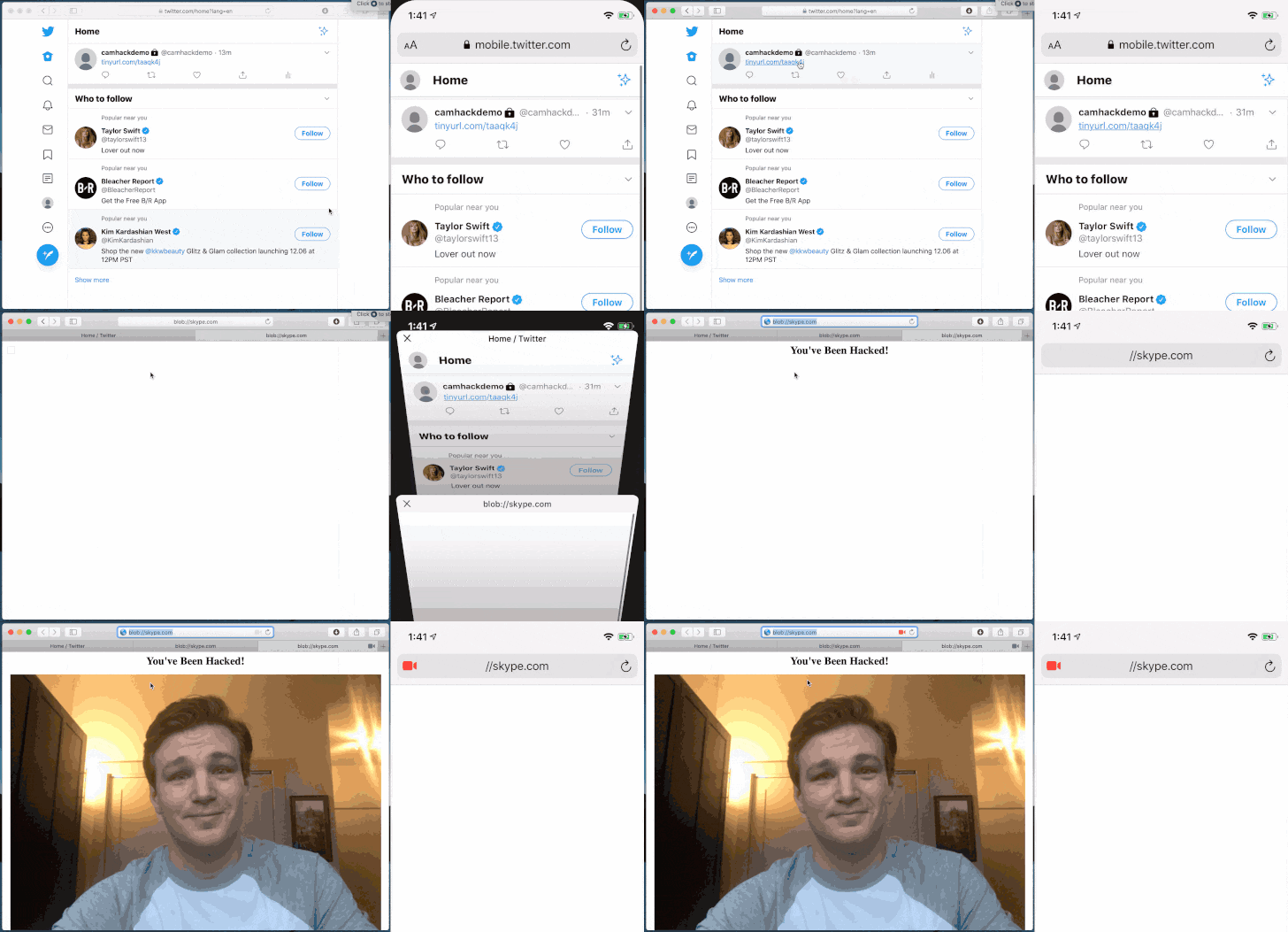
"Safari thinks we are on skype.com, and I can load some evil JavaScript. Camera, Microphone, and Screen Sharing are all compromised when you open my local HTML file," Pickren said.
The research found that even plaintext passwords can be stolen this way as Safari uses the same approach to detect websites on which password auto-fill needs to be applied.
Furthermore, auto-download preventions can be bypassed by first opening a trusted site as a pop-up, and subsequently using it to download a malicious file.
Likewise, a "blob:" URI (e.g. blob://skype.com) can be exploited to run arbitrary JavaScript code, using it to directly access the victim's webcam without permission.
In all, the research uncovered seven different zero-day vulnerabilities in Safari —
If you are a Safari user, it's recommended that you keep the browser up-to-date and ensure websites are granted access to only those settings which are essential for them to function.
The research found that even plaintext passwords can be stolen this way as Safari uses the same approach to detect websites on which password auto-fill needs to be applied.
Furthermore, auto-download preventions can be bypassed by first opening a trusted site as a pop-up, and subsequently using it to download a malicious file.
Likewise, a "blob:" URI (e.g. blob://skype.com) can be exploited to run arbitrary JavaScript code, using it to directly access the victim's webcam without permission.
In all, the research uncovered seven different zero-day vulnerabilities in Safari —
- CVE-2020-3852: A URL scheme may be incorrectly ignored when determining multimedia permission for a website
- CVE-2020-3864: A DOM object context may not have had a unique security origin
- CVE-2020-3865: A top-level DOM object context may have incorrectly been considered secure
- CVE-2020-3885: A file URL may be incorrectly processed
- CVE-2020-3887: A download's origin may be incorrectly associated
- CVE-2020-9784: A malicious iframe may use another website's download settings
- CVE-2020-9787: A URL scheme containing dash (-) and period (.) adjacent to each other is incorrectly ignored when determining multimedia permission for a website
If you are a Safari user, it's recommended that you keep the browser up-to-date and ensure websites are granted access to only those settings which are essential for them to function.
THN
#osutayusuf
Comments
Post a Comment